One of the founders of Ukrainian Transavantgarde, Roman Zhuk, on Children of Vampires, the supernatural, and the one thing he cannot live without
In just under three weeks, Roman Zhuk’s exhibition Children of Vampires on Zenyk Art Gallery’s online platform attracted the interest of more than 130,000 people. By comparison, an exhibition of works by Taras Shevchenko drew around 250,000 over four and a half months. Such is human nature: an irresistible fascination with everything connected to the supernatural and the mystical.
The exhibition’s creator, Roman Zhuk — one of the founders of Ukrainian Transavantgarde — is well known both in Ukraine, where he has long been regarded as a museum artist, and internationally. Born in the Ivano-Frankivsk region, he studied in Lviv and has lived in Amsterdam for the past thirty years.
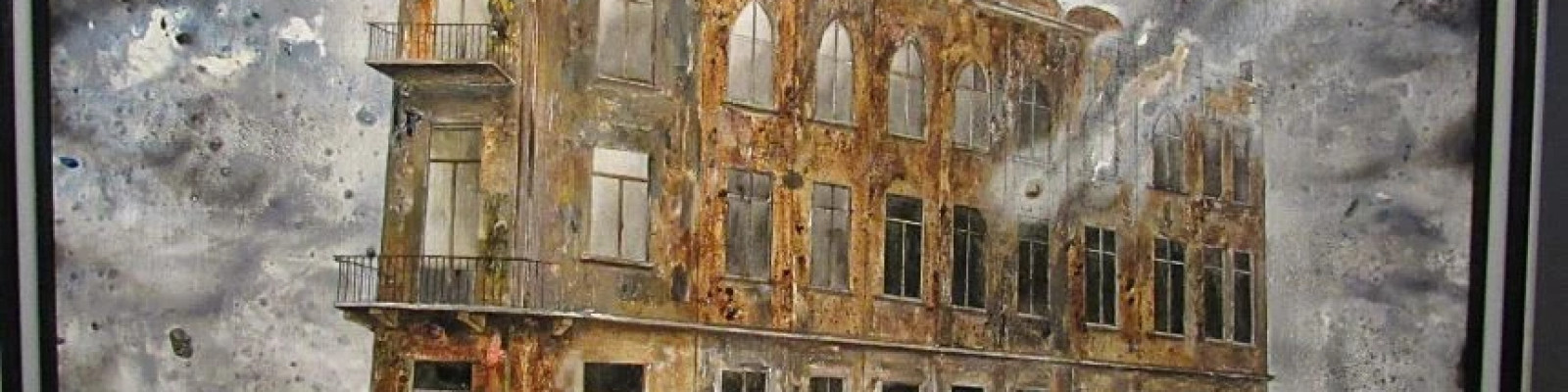
For his project at Zenyk Art Gallery, Zhuk deliberately avoided the images imposed on us by cinema: tall, pale-faced women and men with sharp fangs. Instead, through the visual language of painting, he showed how “mysticism becomes part of reality, while the otherworldly acquires the flesh and blood it so desires.”
“DARKNESS IS NOT ALWAYS HORNS AND FANGS”
Mr Zhuk, in the animated film Hotel Transylvania, which by now has probably become a classic among younger audiences, Count Dracula says: “Humans are the real monsters.” To me, that fits remarkably well with what awaited the viewer in your exhibition Children of Vampires at Zenyk Art Gallery. What do you think?
That animated character is actually quite a wise creature.
Yes, darkness does not necessarily come with visible horns, fangs and a tail. Very often, it is found in people you would never suspect. Beautiful, elegant women, men of status, seemingly defenceless children; people you trust or share your most private thoughts with — and yet, because of them, you suddenly begin to lose your strength.
Someone who feeds on your energy, takes credit for your successes or takes pleasure in your failures…
So vampirism should not be understood literally.
And one of the things about darkness is that it can spread and multiply. How we deal with it depends entirely on us.
According to Ukrainian mythology, vampires — or, in our tradition, upyri or vurdalaky — could look no different from the people living next door, rather than the way popular culture and Hollywood have taught us to imagine them. Vurdalaky were even said to marry ordinary women and have apparently perfectly ordinary children. According to these beliefs, the children of an upyr rarely became upyri themselves; more often, they became their antagonists — people who protected the community from them. Did this idea find its way into your project?
The theme of vampirism is actually extremely broad and rewarding precisely because it allows for so many interpretations.
For me, the title of the project was important because of its underlying meaning. I wanted to emphasise that darkness can continue to spread regardless of whether — metaphorically speaking — we drive an aspen stake through the chest of one of its individual representatives or not.
I begin with the belief that all children are born innocent. It is parents and society who either allow them to abandon good traditions and a sound understanding of life, of good and evil, or prevent that from happening.
And because adults are often so absorbed in themselves that children are essentially left to grow up on their own, it becomes very easy to lead them astray.
The vampire is probably the mythical figure to have undergone the greatest number of reincarnations in cinema, literature and theatre. We might think, for example, of some much-discussed recent films: Robert Eggers’s aesthetically almost flawless, sensual and uncompromising Nosferatu, or Luc Besson’s romantic fantasy Dracula: A Love Tale. Then there is Vampire Carnival, released internationally just now, on 7 October, in which the vampires feed not on blood but on human despair. What drew you personally to this subject and, eventually, to creating the exhibition?
Zenyk Art Gallery and I agreed on my solo exhibition about a year ago.
I know the space well, and I kept thinking about what would suit it best. I already had a cycle of seven works called Children of Vampires, which I myself found interesting — especially because I had personally made a video for it in which I filmed my own shadow while dancing.
So I simply decided to expand the cycle.
Particularly because, when approached more broadly, this is something I think about constantly.
There was another factor that influenced my decision as well.
Before the full-scale invasion, I showed the works that became the starting point for this exhibition at Mystetskyi Arsenal in Kyiv. These were certainly not minor works for me. And I was surprised that they went completely unnoticed.
As though they had never been there.
Did that hurt you?
I wouldn’t say it hurt me, exactly, but I experienced a profound sense of disappointment.
And I genuinely began to worry that this disappointment might take root inside me and make me start doubting myself.
That kind of doubt is very dangerous, by the way.
Not only for artists, but for anyone who creates something.
“OVERCONFIDENCE IS BAD, BUT DOUBTING WHAT YOU DO IS EVEN WORSE”
But we have all known René Descartes’s famous formulation since school: “I doubt, therefore I think; I think, therefore I am.”
There are different kinds of doubt.
If it begins eating away at you, or even destroying you, simply because circumstances or other people have treated you unfairly, then you have a problem.
Overconfidence is a bad quality. But being confident in what you do is extremely important — especially for an artist.
And by nature, I am someone who constantly doubts himself. That has not always served me particularly well, going all the way back to childhood.
For example, I never felt confident in a group, especially among people I didn’t know.
I would constantly try to disappear into the background. I felt awkward among strangers.
And then someone else could walk in, start talking complete nonsense and within five minutes fit right in.
I would always think: how is that even possible?
Even if I wanted to, I couldn’t force myself to do it. I would always be worrying about what to say, whether people were interested, whether I was annoying them…
So perhaps you chose another place in which to lead — art.
No, I didn’t deliberately choose anything.
I simply did what I loved, and I did it the way I felt it should be done.
In general, I am much more comfortable being alone with myself and my thoughts.
That suits me better.
I enjoy being with friends, but I don’t like loud gatherings.
During the exhibition, I came to Zenyk Art Gallery every day — not because I wanted visitors to applaud me and tell me what a great artist I was, but because I wanted to see for myself how the lighting and the video worked together, and to hear what people thought about all of it.
Did anyone say something you hadn’t expected?
I was really struck by how many young people came to see the exhibition and looked at my paintings with genuine interest.
There is a significant age difference between us…
So the fact that young people are attracted to my work and to what I do feels like a compliment.
Older visitors were more interested in developing the philosophical theme of the exhibition. They agreed that there really is such a thing as a force that quietly drains a person’s energy — and that very often it operates through acquaintances, and sometimes even through people close to us.
And I admit that those conversations gave me a great deal of support.
There had been a risk of going too far in one direction, of failing to maintain the balance between conventional ideas about vampires and what I actually wanted to communicate.
THE WORLD, VAMPIRES AND PEOPLE
Mr Zhuk, you come from the Ivano-Frankivsk region, so you can hardly have avoided hearing the legend of the Ivano-Frankivsk upyr — a vampire-like figure in Ukrainian folklore — whose grave was supposedly disturbed in 1936 when an ordinary railway worker was buried above it. According to the story, a local sorcerer managed to drive the vampire back by performing some kind of ritual over the grave. But in the 1970s, the grave was apparently disturbed again, followed by another wave of mysterious murders in the city. The panic was supposedly so intense that the Soviet authorities decided to put a demonstrative end to it by sending in soldiers, who used a flamethrower on the burial site. Fear magnifies everything, as the saying goes, and apparently only that was enough to calm people down.
Something like that really was talked about.
But your story reminded me of one of my own.
I grew up in Tlumach, but my grandmother on my mother’s side was from the village of Vovchynets, just outside Ivano-Frankivsk.
My mother often sent me to stay with my grandmother, and I lived the ordinary life children lived in villages: I helped her, ran around with the other boys and grazed cows.
The Vorona River runs through the village. When I was a child, there was one place below a hill where it spread out very widely.
The hill ended in a steep drop, so there was no way of approaching the water from that side.
When evening came, the echo there became so loud that it was frightening.
The strange thing was that the river itself is a mountain river, with a strong current, rocky banks and a stony bed. But in this particular place, for some reason, it became eerily quiet and almost motionless.
The local boys used to say that the devil walked there at night, rattling chains.
I’ve only just thought of this now: in my memory, the whole thing comes back so vividly, so pictorially, that I absolutely have to paint it.
But whether there really was something supernatural there, or whether the sound had a perfectly natural explanation, nobody ever tried particularly hard to find out.
Mysticism has a special power of attraction.
I agree. But in earlier centuries, an excessive preoccupation with the supernatural could cost someone their life. In the town of Čelákovice near Prague, a local resident trying to connect water to his house in 1966 dug up human bones. Frightened, he called the police. Once they established that the bones belonged to history rather than a contemporary crime, museum specialists and archaeologists were called in. Eventually, they discovered a highly unusual burial ground, dated at the time to the late tenth or early eleventh century. All fourteen of the men buried there showed signs interpreted as anti-vampire rituals. The bodies of these unfortunate people had been bound; some were lying face down; many had been decapitated or had their chests pierced with aspen stakes. The disturbing discovery was consequently described as Europe’s first entirely “vampire” cemetery.
And, interestingly, even monarchs tried to combat popular superstition. In the mid-eighteenth century, the Austrian Empress Maria Theresa sent her own physician to investigate alleged vampire attacks. He even produced a study arguing that it was all nonsense, after which the Empress issued a decree forbidding people from fighting vampires using the customary methods. It seems, however, to have had relatively little effect.
What can you do? People are people.
We are frightened by anything we cannot explain.
Epidemics, fires, floods…
How could we resist finding someone to blame?
Even Vlad the Impaler, the famous ruler of Wallachia whom children today know as the vampire Dracula, may have been extraordinarily cruel, but he does not appear to have sucked anyone’s blood.
Not literally, at least.
There is no evidence whatsoever that he possessed supernatural powers.
But there is human imagination — which, in his case, was stimulated several centuries after his death by the Irish writer Bram Stoker, followed closely by Hollywood.
And there is the human mind’s tendency to perceive the world through the mystical.
For me, even something entirely real can sometimes seem mystical in a certain sense.
And it does not necessarily have to happen at night.
Looking at an ordinary flower, in a particular state of mind or under a particular light, can become the impulse not only for a single image, but for the birth of an entire world.
Because you are an artist. Someone who sees. As Leonardo da Vinci is said to have put it, there are three kinds of people: those who see; those who see when they are shown; and those who do not see.
Bram Stoker’s novel Dracula was published at the end of the nineteenth century, and less than fifteen years later the German physician Hans Günther identified a new, though rare, disease — porphyria — involving a genetic disorder in the synthesis of haem in human blood. As specialists explain it, instead of haem, by-products of its synthesis accumulate in the body. As a result, people with certain forms of the condition may have extremely pale skin, develop severe lesions after exposure to sunlight, suffer intense internal pain, and so on… To an ordinary person, wouldn’t that look rather like a vampire? In other words, superstition very often grows from ignorance.
Do you have any plans to show this exhibition somewhere else? In Amsterdam, for example? The themes you explore in Children of Vampires have no borders.
I don’t think the galleries there would be particularly interested in this subject.
For the most part, unlike galleries in Ukraine, they are focused almost exclusively on commercial results.
And the average buyer is unlikely to purchase paintings with such a specific thematic focus.
Does that discourage you? And where — or in what — do you find inspiration?
No, not at all!
As for inspiration, it is actually quite prosaic.
I love painting, and I try to create the conditions in which I can paint comfortably.
I have never waited for some extraordinary state of inspiration before working.
More generally, I am used to relying only on myself.
The main thing is to remain interested in life.
The desire to paint, and the energy to do it, have remained constant in me to this day.
And I make full use of that.
TECHNIQUE ALONE DOES NOT CREATE TRUE ART
Where do you spend more of your time today — in Lviv, to which you constantly return, or in Amsterdam, where you have lived for thirty years? Where do you feel most at home?
I am comfortable everywhere.
Although because of the war and the constant threat of missile strikes, life is probably calmer in the Netherlands at the moment.
But creatively, it makes very little difference where I am — Ukraine, the Netherlands or the United States.
Creating art itself is what makes me happy.
People who do not know your biography in detail might wonder: why did you emigrate?
It happened almost by accident.
In the 1990s, the borders opened, and I — along with people like me — rushed out to see whether the world in the West really was the way we had imagined it.
We wanted to visit absolutely every museum and see the contemporary art we had only heard fragments about.
There was no internet yet, no mobile phones either. The Iron Curtain had only just fallen, so information was scarce.
And when you are young, you do not spend much time thinking: I have no money, nowhere to live, nothing to eat.
You simply go.
We would have been prepared to walk there if that was what it took to discover the world.
As it happened, I began having many exhibitions in Amsterdam, including solo exhibitions.
Then people started buying my paintings.
At first, I was surprised.
And then I gradually began to find my feet.
More and more things connected me to the Netherlands, and the birth of my son only strengthened my bond with the country.
When did you feel that, creatively, you had become yourself? That Roman Zhuk was not Max Ernst, René Magritte, or anyone else with whom art historians sometimes try to compare you, but Roman Zhuk — an artist who had found his own path?
To be honest, I never thought about it very much.
But when I arrived in Europe in the 1990s, I realised how dangerous it can be to fall under the influence of artists you admire deeply.
I love Michelangelo, for example, and Jackson Pollock, as well as certain abstract artists, but I would never want to copy them.
You can follow the example of masters you admire in their depth, their understanding of what art is, their dedication.
But not in what they actually created.
What they created was the result of their own search, their own personality.
Every artist has to discover themselves.
If you truly devote yourself to that search, a result will come.
The outer shell is not nearly as important as what a painting actually carries within it.
The technical side of art has always been important to me as well.
I drew constantly.
I wanted to become a professional in terms of technical mastery too.
When I was about eleven, our art teacher brought an issue of the magazine Ogonyok to our drawing class and showed us a selection of Michelangelo’s drawings that had been reproduced there at very high quality — torsos, parts of the body, portraits.
I simply froze.
Everything was so perfect.
And then I went and said:
“I’d like to be able to draw like Michelangelo.”
The other children started laughing at me.
But over time, I only became more convinced that having reference points — people to aspire towards — is extremely important.
No, I did not want to imitate Michelangelo’s outlines or forms.
I wanted his depth, his ease…
I think God simply sent that man so that we could understand how one should work in art, so that we would have someone to look towards.
Salvador Dalí put it very well:
“Have no fear of perfection — you’ll never reach it.”
Today, I have a very strong command of technique because I have devoted an enormous amount of time and effort to it.
But I also know very clearly that art is not created by technique or technology.
Above all, it is created by something else — by an inner force that cannot be reached without work.
A vase painted by one artist may be empty, primitive and meaningless.
The very same vase, painted by someone else, becomes a work of art.
No one knows exactly how that happens.
That is why an artist has to give themselves completely to what they do.
Very often, it means working extremely hard.
But that work is an enormous pleasure.
Personally, I cannot live without it.
It is what makes me happy.
This material is reproduced from a publication by Espreso.West.
The article is available at this link